The Cult of the Checkbox: When Productivity Advice Becomes a Cage
Ever notice how productivity advice is supposed to make life easier… but somehow leaves you feeling watched instead? A reflection on trust, messiness, and what happens when we stop trying to manage ourselves and start paying attention instead.
The Cult of the Checkbox: When Productivity Advice Becomes a Cage
Have you noticed how reading productivity advice sometimes leaves you feeling… smaller?
Not motivated.
Not inspired.
Just vaguely supervised.
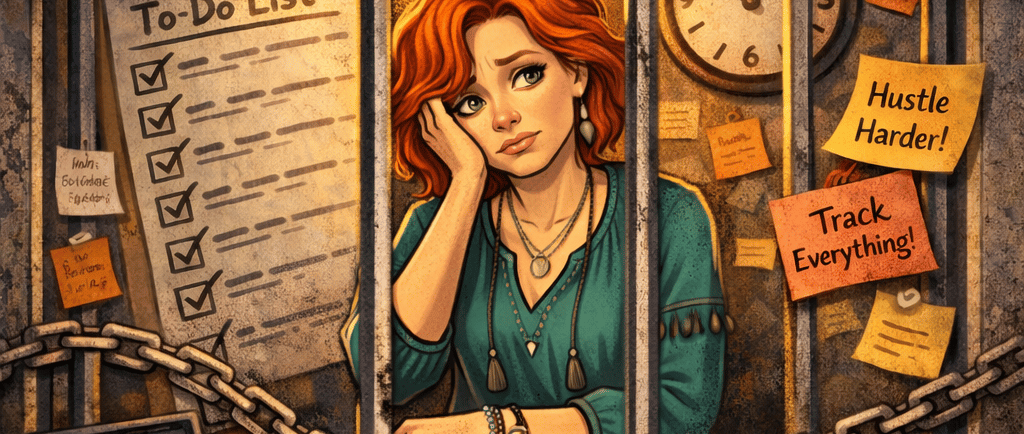
Like someone handed you the keys to a very efficient prison and said, “Congrats, you’re in charge now.”
I’ve been thinking about this a lot lately. Not in the “let me optimize my thinking about thinking” way, but in the “why does all of this make me feel like I’m failing at being a human?” way.
Here’s the pattern I keep noticing: most productivity advice quietly assumes we can’t be trusted.
That what we’re missing isn’t freedom, or self-knowledge, or room to breathe—but a better overseer. A more elegant system of surveillance. A cuter checklist app.
Which might explain why it never quite works the way the article promises.
The Promise of Control (That Feels Like Control)
Open almost any productivity guide and you’ll see the same basic blueprint:
Break your day into smaller pieces
Track those pieces carefully
Measure yourself against them
Adjust when you “fail”
Repeat tomorrow
Sound familiar?
It’s the same structure used to manage people who aren’t trusted. The only twist is that now we’re doing it to ourselves.
We’ve become both the manager and the employee.
And somehow, neither one seems very happy.
When I notice myself reaching for yet another system, I try to pause and ask: What am I actually looking for right now?
And most of the time, it’s not efficiency.
It’s the feeling that someone—anyone—is watching.
Caring.
Keeping me from wasting my time.
Making sure I matter.
Which is… kind of heartbreaking, if you sit with it for a second.
What We Actually Need (And Why It’s Uncomfortable)
I wonder if what we really need isn’t better systems—but more trust in our own rhythms.
Not the motivational-poster version of “trust yourself,” but the much messier practice of noticing what’s working without immediately trying to optimize it.
Of watching ourselves move through work without turning that watching into control.
This is harder than it sounds.
Because if we’re not managing ourselves with elaborate systems, we’re left with the uncomfortable question of whether we’re “doing enough.”
We have to tolerate not knowing.
Not tracking.
Not getting gold stars from a timer or an app.
We have to—stay with me here—trust that we’re already whole people who know how to make meaningful things without constant supervision.
Even when the process is messy.
Even when it doesn’t fit neatly into 25-minute blocks.
Even when it looks suspiciously like wandering before it looks like progress.
The Questions That Might Actually Help
Instead of asking, “What’s the best productivity system?”
What if we asked:
Why don’t I trust myself without one?
Instead of, “How do I optimize my time?”
What if we asked:
What would my days look like if no one was watching?
Instead of, “How do I track my progress?”
What if we asked:
What if the point isn’t to track—just to notice what I’m already making?
These questions don’t come with templates.
They don’t offer app recommendations.
They don’t promise you’ll finally feel “on top of things.”
But they do something more interesting.
They shift the conversation from control to awareness.
What I’m Trying Instead
(And Why It Feels Different)
I’m not here to give you a new system. That would be… ironic.
But I am curious about what happens when we notice the impulse to micromanage ourselves—and pause right there.
Not to fix it.
Not to override it.
Just to see it.
What happens when we let the chaos surface before rushing to clean it up?
Because here’s what I’ve been noticing: before clarity shows up, there’s almost always a pile. A swirl. A jumble of half-formed thoughts, tabs, feelings, and “I’ll deal with that later.”
And instead of trying to force that mess into a perfectly labeled system, I’ve been experimenting with something simpler—giving the chaos somewhere safe to land.
Not to organize it immediately.
Not to turn it into a plan.
Just to see it clearly.
Funny thing is… once you can see the chaos, clarity tends to follow on its own.
Not because you forced it.
But because you finally stopped fighting what was already there.
I’m curious—how do productivity systems feel to you? Like support… or like surveillance?
And what happens when you let the mess speak before trying to manage it?
Let’s just notice together.
Just a Nosy Rosy
Curious. Kind. Honest.
Contact
rosy@justanosyrosy.com
© 2025. All rights reserved.